For foreign nationals pursuing U.S. permanent residence through the EB-2 National Interest Waiver (NIW), understanding eligibility is only part of the process. The next step is demonstrating that eligibility with a petition that is complete, well-organized, and supported by the right evidence.
Petitioners often have many questions about how to apply:
- Which forms are required?
- In what order must they be submitted?
- What documentation does USCIS expect, and how should it be presented?
This guide addresses those questions, from selecting a filing strategy through what to expect after USCIS receives your petition, for foreign nationals who have determined that the EB-2 NIW is the appropriate pathway and are ready to understand how the application process works in practice.
What is the EB-2 NIW Application Process?
The EB-2 NIW stands apart from most employment-based green card categories because it allows for self-petitioning and does not require a U.S. employer to sponsor you. The petition is built around your own professional record. Unlike most employer-sponsored green card categories, the EB-2 NIW waives the labor certification (PERM) requirement, which is a process by which an employer would normally need to demonstrate that no qualified U.S. workers are available for the position.
Two variables shape your path above all others: where you currently live, and which country you were born in. Both affect which forms you file and how long the process takes. The steps below walk through each the steps for each path.
For a broader overview of the category, eligibility, and how USCIS evaluates these petitions, see our complete EB-2 NIW guide.
Step 1: Determine Your Filing Strategy
Understanding which path applies to your situation is essential for beginning the application process. Your filing strategy determines which forms you submit, in what order, and whether you can stay in the United States throughout the process. It is also shaped by your country of birth: applicants from India and China face priority date backlogs that affect when they can complete certain steps. The two main routes are concurrent filing and consular processing, as explained below.
Concurrent filing from within the United States
This option is available to applicants already in the United States who hold a valid immigration status and have a current priority date, meaning the date your I-140 was filed is now eligible for processing under the State Department’s monthly Visa Bulletin.
When you file concurrently, your immigrant petition and your application to adjust status go to USCIS in the same package. Once the I-485, Application to Register Permanent Residence or Adjust Status is pending, you can also apply for an Employment Authorization Document (EAD) using Form I-765, Application for Employment Authorization, and for Advance Parole, a travel document that allows you to leave and re-enter the United States while your green card application is pending, using Form I-131, Application for Travel Document. These allow you to work legally and travel internationally while your case is going through adjudication, the formal review process in which USCIS evaluates and decides your petition. For most applicants born outside India and China, a current priority date is already available.
Consular processing for petitioners outside the United States
This path applies to EB-2 NIW petitioners who are living outside the United States, or who choose to finish the process abroad even if they are currently in the U.S. After USCIS approves the I-140, the case transfers to the National Visa Center (NVC), which collects your civil documents and fees. Once your case is documentarily complete, the NVC forwards it to the U.S. embassy or consulate in your home country, which schedules your immigrant visa interview. You enter the United States as a lawful permanent resident after the interview, and the physical green card is mailed shortly after.
The India and China backlog
Applicants born in India or China face a priority date queue that can span years between I-140 approval and the ability to file the I-485. The State Department updates these cutoff dates monthly in the Visa Bulletin. For further guidance, read our articleshow the Visa Bulletin affects EB-2 NIW petitioners and how to read the Visa Bulletin.
Step 2: Gather Your Supporting Documents
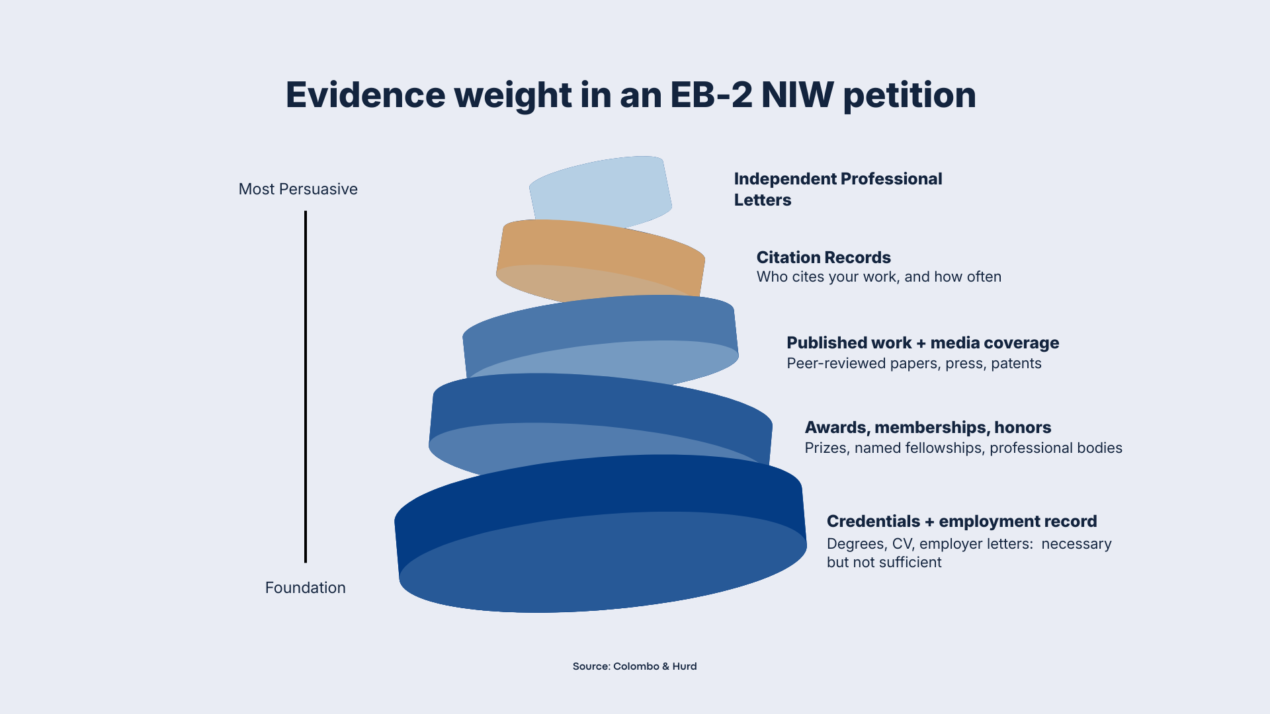
A well-prepared evidence package is what makes an EB-2 NIW petition work. Your attorney will use these materials to build the petition letter, so gathering them early keeps the process moving. The list below covers what USCIS typically expects to see.
Think of your evidence in two categories: baseline credentials that establish your professional background and supporting materials that demonstrate the significance of your work. Having both in good shape gives your attorney the strongest possible foundation to work from:
- Valid passport and copies of all U.S. visa stamps and entry records
- Diplomas, transcripts, and a credential evaluation for any foreign degrees
- Updated curriculum vitae or resume
- Published research papers, articles, books, or other authored works
- Documentation of citations to your work by independent researchers or practitioners
- Letters of recommendation from qualified professionals in your field (see below)
- Evidence of awards, prizes, honorary memberships, or fellowships
- Employment verification letters confirming your professional history
- Patents, licenses, or documented evidence of original innovations
- Published news coverage, media articles, or press about your work
All foreign-language documents must include a certified English translation.
Letters of Recommendation: What Makes Them Strong
The most persuasive letters come from independent professionals: senior researchers, practitioners, or field leaders who have no personal or professional relationship with you, meaning no co-authorship, no current institutional affiliation, and no direct reporting relationship, past or present. A letter from a well-regarded figure at another institution who has followed your work from a distance and can speak to its significance without any personal stake carries more weight with USCIS than someone who works alongside you every day.
Each letter should describe your contributions and explain why those contributions matter at a national or field-wide level and connect your work to a concrete benefit for the United States. Plan on gathering between three and six letters, with at least two or three coming from individuals who have no direct professional tie to you.
Step 3: Prepare the Petition Letter
Once your evidence is assembled, your attorney can begin drafting the petition letter. This is a detailed legal document that presents your background and contributions within the specific framework USCIS uses to evaluate EB-2 NIW petitions, with each argument tied directly to your evidence.
The letter must accomplish three things under that framework. It must establish that your proposed work has substantial merit and national importance. It must show that you are well-positioned to advance that work, with a track record, expertise, and specific plans that support that claim. And it must argue that waiving the standard job offer and labor certification requirement serves the interests of the United States. Each of those three arguments must be backed by concrete evidence. The letter is where the connection between your documents and the legal standard gets explicitly made.
Depending on the complexity of your case, the petition letter can range anywhere from several pages to significantly longer. Understanding what USCIS officers look for in an EB-2 NIW petition can help you prepare the strongest petition. Working with an experienced EB-2 NIW attorney at this stage gives your petition the clearest path to a strong outcome.
Step 4: File Form I-140 (Immigrant Petition for Alien Workers)
With your petition letter drafted and your evidence package organized, you are ready to file. Form I-140 is the official USCIS form through which you request classification under the EB-2 NIW category. For self-petitioners, you are both the petitioner and the beneficiary.
Where to file
USCIS routes I-140 petitions to either the Nebraska Service Center or the Texas Service Center based on the petitioner’s state of residence. Before assembling your package, your attorney will confirm the correct filing address on the USCIS I-140 page, as direct filing addresses are updated periodically.
Filing fees
Before beginning the EB-2 NIW process, it’s important to understand the government filing fees involved. These fees cover the cost of submitting petitions and applications to USCIS. USCIS fees are subject to change, so always confirm the latest amounts on the USCIS Fee Schedule.
| Category | Fee |
| Form I-140 (Immigrant Petition for Alien Worker) | $715 for paper filing or $665 for online filing(additional fees may apply) |
| Premium Processing (optional) | $2,965 |
Processing times: Standard I-140 processing times fluctuate significantly based on service center volume. Rather than relying on any estimate printed here, check the USCIS processing times tool directly for current figures at each service center.
Premium processing is available for an additional $2,965, which requires USCIS to issue a decision within 45 business days. It only accelerates the I-140 review and does not change your priority date or visa availability.
What Happens After Your I-140 Is Approved
An approved I-140 locks in your priority date and officially establishes your eligibility for the EB-2 NIW category. What comes next depends on two things: where you are living, and whether your priority date is current.
| Next Step | Estimated Timeline |
| Adjustment of Status (in the U.S., priority date current) | 6 to 12 months |
| Consular Processing (abroad) | 4 to 12 months, depending on embassy workload |
Always check the USCIS processing times tool for current figures, as these estimates shift with service center volume.
For applicants born outside India and China, a current priority date is typically available immediately. For applicants born in India or China, there may be a wait before the priority date becomes current. The State Department updates these cutoff dates monthly in the Visa Bulletin.
If your priority date is current and you are in the United States, proceed to Step 5. If you are abroad or waiting on a priority date, your attorney will advise on timing for the next stage.
Step 5: File for Adjustment of Status (If Applicable)
If you are in the United States and your priority date is current, this is the step that turns your approved I-140 into a green card application. Adjustment of Status (AOS) is the process by which a foreign national lawfully present in the U.S. applies to become a permanent resident without leaving the country.
The core form is the I-485. For concurrent filers, the I-485 goes to USCIS in the same package as the I-140. Most applicants also submit Form I-765 to apply for an Employment Authorization Document (EAD) and Form I-131 to apply for Advance Parole in the same package. Both documents become available while the I-485 is pending, giving you the ability to work legally and travel internationally during the adjudication process.
Step 6: Biometrics Appointment
After USCIS receives and accepts your I-485, you will receive an appointment notice in the mail scheduling you for a biometrics appointment at a local Application Support Center (ASC). The appointment itself is brief, typically under 30 minutes. A USCIS officer will collect your fingerprints, photograph, and signature, which are used to run background and security checks.
Step 7: What to Expect After you File
Once your petition is submitted, USCIS takes over the review process. Your main responsibility during this period is to watch for notices, respond to any requests on time, and keep your contact information current with USCIS. Here is what to expect:
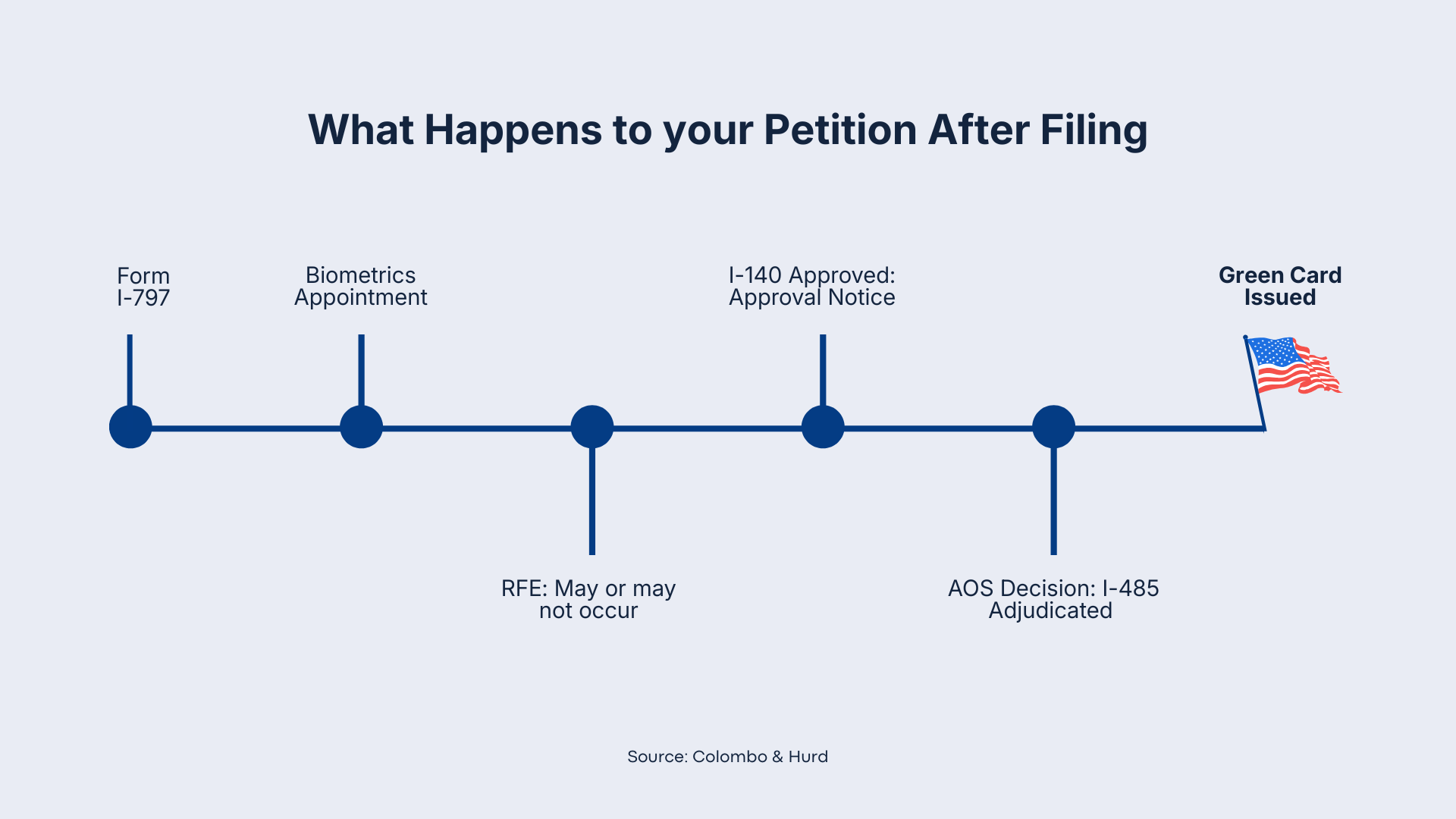
Receipt notice: Within a few weeks of filing, USCIS will mail a receipt notice (Form I-797) confirming they have accepted your petition for processing. This notice contains your receipt number, which you can use to track your case status on the USCIS website. Keep this document. It is your primary reference for everything that follows.
Request for Evidence (RFE): If USCIS requires additional documentation or finds that part of your argument needs strengthening, they will issue an RFE. This is a formal written request that specifies exactly what is needed. RFEs come with response deadlines, typically 87 days. Responding thoroughly and on time is important. A well-prepared response, drafted by your attorney, addresses every USCIS concern directly and supplements the record with any missing evidence.
Interview: USCIS does not routinely schedule interviews for EB-2 NIW petitioners, though they retain the discretion to do so. If an interview is scheduled, your attorney will walk you through preparation.
Approval and what comes next: An approved I-140 means USCIS has officially recognized your eligibility for the EB-2 NIW category and locked in your priority date. For concurrent filers, the I-485 continues through its own adjudication process, which eventually results in a green card being mailed to you. For applicants who are waiting on a priority date, the I-140 approval is the foundation you will build on when that date becomes current.
Common Mistakes to Avoid When Filing Your EB-2 NIW Petition
Filing without a well-developed petition letter is the most common trigger for RFEs. Form I-140 includes the administrative record, but it is the petition letter that makes your case. A letter that is too brief or too generic tends to leave the legal argument underdeveloped, which is something a good attorney will address from the start.
Submitting original documents instead of certified copies is an easy mistake to avoid. USCIS does not return original documents once received, so certified copies are the right choice for all supporting materials. USCIS will request originals through an RFE if they are specifically needed.
Missing certified translations is a straightforward fix. Every foreign-language document in your package, including diplomas, transcripts, employment letters, and publication records, needs a complete English translation with a written certification from the translator. This applies to all such documents without exception.
Generic recommendation letters carry less weight than they should when they focus on general praise rather than specific contributions. The most useful letters describe what you contributed, explain why it matters at a national level, and connect it to a concrete benefit for the United States. Exploring concurrent filing when you are eligible is worth discussing with your attorney if you are unsure whether it applies to you. If your priority date is current and you are in the United States, filing the I-485 alongside the I-140 means you can apply for work authorization and Advance Parole at the same time.
Missing RFE response deadlines can set back your timeline significantly. USCIS treats a missed deadline as a withdrawal of the request. Adding every USCIS deadline to your calendar as soon as a notice arrives keeps you on track.
Using outdated USCIS forms is another easy one to sidestep. USCIS updates its forms periodically, and submitting an older edition can result in the package being returned. Always download the current version directly from uscis.gov immediately before filing.
Work With an Attorney Who Knows the EB-2 NIW
Building a strong EB-2 NIW case requires knowing which evidence carries the most weight for your specific background, how to frame your contributions within the legal standard USCIS applies, and how to anticipate the questions an adjudicator is likely to raise. That is where experienced legal counsel makes a measurable difference.
Our attorneys at Colombo and Hurd have guided professionals across industries and nationalities through every stage of the EB-2 NIW process, from early case assessment through filing and beyond. If you are ready to evaluate your record and understand your options before committing to a filing strategy, the first step is to schedule a free profile evaluation.