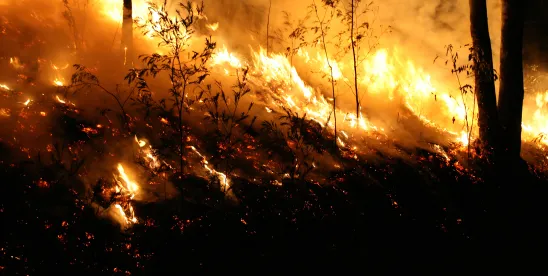
Businesses in the agriculture, construction, and tourism industries may need to take extra safety precautions as required under federal and state laws to protect their employees in Florida, Georgia, and South Carolina, where smoke from wildfires that ignited in April 2026 are causing unhealthy air quality.
Quick Hits
- Parts of Florida, Georgia, and South Carolina are experiencing unhealthy air quality due to wildfire smoke.
- Employers may need to take safety precautions against wildfire smoke to comply with the federal Occupational Safety and Health (OSH) Act and certain state-level laws.
- Some workers have disabilities that require reasonable accommodations when air quality is poor.
With heavy wildfire smoke, harmful particles, gases, and ash can seep into workplaces and homes through doors, windows, and ventilation systems, even when the doors and windows are closed.
The general duty clause of the Occupational Safety and Health (OSH) Act requires employers to provide a workplace free from recognized hazards causing or likely to cause death or serious physical harm, including wildfire smoke. Likewise, California, Nevada, and Washington have state laws that protect workers from wildfire smoke hazards.
Employers can take safety precautions like monitoring the local air quality index (AQI), performing regular maintenance on ventilation systems, keeping windows and doors closed, using air filters, and training workers to recognize the signs of excessive smoke exposure, such as chest pain, heart palpitations, dizziness, and fatigue.
Wildfire smoke may aggravate symptoms for people with asthma, chronic obstructive pulmonary disease (COPD), bronchitis, pneumonia, and migraines. It also may present extra health risks for pregnant people and anyone at higher risk of heart attack or stroke. Depending on the individual’s specific symptoms and limitations, these conditions may qualify as a disability under the federal Americans with Disabilities Act (ADA) and similar state laws. If the medical condition is short-term and relatively mild, then it may not meet the criteria for a disability under the ADA.
Disability Accommodations
For employees with a known disability, employers must engage in an interactive dialogue to identify a reasonable accommodation that allows the employee to perform the essential functions of the job. During times of heavy wildfire smoke, some employees may ask for reasonable accommodations that they don’t need on days with good air quality.
Reasonable accommodations under the ADA may include remote work, scheduling flexibility, closing windows, permitting longer rest breaks, providing N95 respirators, reducing physical demands of the job, and improving indoor air filtration with HEPA filters and HVAC maintenance.
To justify denying a reasonable accommodation, an employer must demonstrate that the accommodation would impose an undue hardship, meaning a significant cost or difficulty for business operations.
Accommodations do not need to be permanent or set in stone. They can be adjusted as air quality and worksite conditions change.
Next Steps
In locations with an unhealthy AQI, employers may wish to consider making adjustments to work schedules, reducing the physical demands of work, or moving work indoors if possible. Applying accommodations fairly and consistently can help to prevent discrimination lawsuits based on disability, gender, or other protected characteristics.