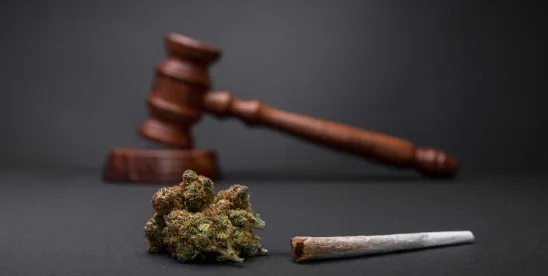
Facing the very real possibility of execution for speaking in favor of the independence of the soon-to-be United States, Patrick Henry, in his famous “Give me liberty or give me death” speech, said:
In proportion to the magnitude of the subject ought to be the freedom of the debate. It is only in this way that we can hope to arrive at truth, and fulfill the great responsibility which we hold to God and our country.
The First Amendment and marijuana have had a deeply complicated relationship, largely because of the seemingly simple (but practically complicated) question of how to treat speech about a product that is federally illegal and yet legal in more than 40 states.
Historically, marijuana operators have been extraordinarily limited in their ability to advertise their products at both the federal and state level. We’ve written before about the interplay between businesses in the cannabis space and their right to free speech under the First Amendment. The rescheduling of marijuana to Schedule III status meaningfully shifts that dynamic.
The Core First Amendment Problem Marijuana Operators Have Faced
To understand the potentially seismic shift that may occur in First Amendment jurisprudence with rescheduling, we must first understand just how comprehensively federal illegality has suppressed marijuana speech across virtually every communications channel. Marijuana operators have been living in a First Amendment desert — unable to advertise on major digital platforms, locked out of mainstream media advertising, denied access to the postal system for marketing materials, blocked from payment processors that would enable e-commerce, and subject to state advertising restrictions that would be constitutionally suspect in any other commercial context.
The federal illegality of marijuana created a cascading series of speech restrictions that operated through both direct government action and private platform decisions driven by the fear of potential legal risk. The result has been a commercial speech environment for marijuana that looks nothing like other industries — even heavily regulated ones like alcohol, tobacco, and pharmaceuticals.
Schedule III arguably changes the entire foundational premise of the last few decades of First Amendment law regarding marijuana. Let’s work through the specific channels.
Commercial Speech Doctrine — The Central Framework
Commercial speech — speech that proposes a commercial transaction — receives First Amendment protection under the framework established in Central Hudson Gas & Electric Corp. v. Public Service Commission. Under Central Hudson, the government may regulate commercial speech only if the speech concerns lawful activity, the government has a substantial interest in restricting it, the regulation directly advances that interest, and the regulation is no more extensive than necessary.
Not surprisingly, the first prong of Central Hudson has been the death knell for marijuana operators challenging advertising restrictions. Courts have consistently held that speech proposing transactions in federally illegal goods does not concern lawful activity and therefore receives no First Amendment protection. Game over.
Schedule III flips that first prong for state-licensed medical marijuana operators and FDA-approved marijuana products, both of which are now federally lawful. Speech proposing transactions in those products concerns lawful activity. The Central Hudson analysis now proceeds to the remaining prongs — and marijuana operators will find considerably friendlier terrain there than they’ve ever encountered before.
This is, to put it plainly, a constitutional revolution for medical marijuana commercial speech.
Digital Advertising — The Big One
Facebook, Instagram, Google, Twitter/X, and virtually every major digital advertising platform have self-imposed categorical prohibitions on marijuana advertising that are driven primarily by federal illegality concerns. These aren’t government actors, so the First Amendment doesn’t directly apply to their platform decisions — but their policies are downstream of the federal legal environment in important ways.
These platforms have been unwilling to accept marijuana advertising for a combination of reasons: federal law compliance concerns, payment processor policies that reflect federal illegality, and brand safety considerations. Schedule III doesn’t immediately open these platforms to marijuana advertising — they will move cautiously and deliberately — but it removes the most fundamental legal barrier to their doing so.
We would expect to see a phased opening of digital advertising platforms to Schedule III-compliant medical marijuana operators, likely beginning with the most cautious and limited formats and expanding over time as the platforms develop comfort with the regulatory framework. Google has already shown some movement on marijuana-adjacent advertising — hemp, CBD, and related products — and Schedule III medical marijuana is the logical next step in that progression.
For marijuana operators who have been pouring money into SEO, organic social media, and other workaround strategies because paid digital advertising was unavailable, the opening of these channels represents a fundamental shift in the marketing landscape. The operators who move quickly to develop digital advertising competencies will have a significant advantage.
State Advertising Restrictions — Now Constitutionally Vulnerable
State advertising restrictions on marijuana have been insulated from serious First Amendment challenge by the federal illegality argument. Courts applying Central Hudson have simply stopped at the threshold question: The speech concerns unlawful activity, so no protection applies and the state can restrict it however it wants.
Post-rescheduling, state advertising restrictions on Schedule III medical marijuana operators must now survive Central Hudson scrutiny. Some restrictions probably will; some likely will not.
- Prohibitions on advertising near schools or in media likely to reach minors probably survive Central Hudson. The government has a substantial interest in protecting minors. The key question will be whether the particular restrictions directly advance that interest in a narrowly tailored way. These look a lot like the alcohol and tobacco advertising restrictions that courts have generally upheld — though we predict there will be instances in which the government’s efforts are overbroad.
- Categorical prohibitions on television, radio, or digital advertising for medical marijuana are considerably more vulnerable. If the government’s interest is preventing youth exposure or reducing demand for marijuana generally, a categorical ban on an entire medium is hard to defend as no more extensive than necessary when less restrictive alternatives — like time-of-day restrictions or audience demographic requirements — are available.
- Restrictions on health claims or therapeutic representations are trickier. The FDA’s regulation of drug advertising — which now potentially applies to Schedule III marijuana products — creates a federal framework for health claims that may preempt some state restrictions while imposing its own requirements. This intersection of First Amendment commercial speech doctrine and FDA drug advertising regulation is genuinely uncharted territory for marijuana.
- Mandatory warning label requirements almost certainly survive Central Hudson — the government’s interest in consumer information is substantial, and compelled disclosure of truthful factual information receives more deferential treatment under Zauderer v. Office of Disciplinary Counsel.
Professional Speech — The Physician Recommendation Question
Here’s a First Amendment dimension that often gets overlooked. Physicians in many states have faced restrictions — sometimes informal, sometimes formal — on their ability to discuss or recommend marijuana with patients. Some of these restrictions have come from private hospital systems and medical practices rather than government actors, but government-imposed restrictions on physician speech about marijuana have existed in various forms.
Rescheduling could dramatically change the professional speech landscape for physicians. Recommending a Schedule III controlled substance is categorically different from recommending a Schedule I substance in the professional speech context. The government’s ability to restrict physician speech about Schedule III medical marijuana becomes considerably more attenuated post-rescheduling, and we would expect to see both an erosion of informal and formal barriers to physician marijuana communication relatively quickly in some places and perhaps more deliberately in others.
For medical marijuana operators, this means that the physician referral channel — which has always been theoretically important but practically constrained — may open up in meaningful ways. Building relationships with physicians who can now speak more freely about medical marijuana recommendations is a significant business opportunity, and any state law attempting to restrict such communications now stands on much more tenuous constitutional footing.
The Banking-Speech Nexus
Here’s a less obvious First Amendment connection worth flagging. Marijuana operators have been unable to use many conventional payment and advertising platforms not just because of direct legal restrictions but because payment processors — Visa, Mastercard, American Express — have refused to process marijuana transactions, which has in turn prevented marijuana operators from accessing e-commerce platforms, digital advertising platforms that require payment processing, and other commercial speech channels.
Schedule III status improves the payment processing picture for medical marijuana operators in ways that have downstream First Amendment implications. As payment processors become more comfortable with Schedule III-compliant medical marijuana transactions, the e-commerce and digital advertising channels that depend on payment processing begin to open up. Freedom of speech and the commercial freedom are deeply intertwined here.
The First Amendment implications of rescheduling are structurally complex, but they hold together around a central principle: Federal lawfulness is the key that unlocks commercial speech protection, and Schedule III just handed state-licensed medical marijuana operators that key for the first time.
What Hasn’t Changed — The Recreational Operators
We would be remiss not to note that recreational marijuana operators remain in exactly the same First Amendment desert they’ve always inhabited. Schedule I means federally unlawful, means no Central Hudson protection, and means states can restrict advertising however they want. The two-tier constitutional landscape — medical operators with growing speech protections, recreational operators with none — is going to create some fascinating competitive dynamics in states with both programs.
Recreational operators will have strong incentives to push into medical markets not just for the 280E relief and banking benefits we’ve discussed, but for the First Amendment advertising advantages that flow from Schedule III status. The ability to advertise through digital platforms, direct mail, and other previously unavailable channels could be a significant competitive differentiator for medical-focused operators in dual-program states.
Practical Next Steps for Operators
For state-licensed medical marijuana operators thinking about First Amendment implications of rescheduling, here’s where to focus:
- Review your existing advertising and marketing restrictions under state law with fresh constitutional eyes. Provisions that seemed unassailable under Central Hudson‘s first prong may now be vulnerable, and identifying those provisions is the first step toward either compliance planning or potential challenge.
- Begin building digital advertising capabilities and relationships with platform representatives. The platforms will move cautiously, but operators who are ready to move when the platforms open up will have a significant head start.
- Engage with physician communities about the changed professional speech landscape. The ability of physicians to discuss and recommend Schedule III medical marijuana more freely is a significant patient acquisition opportunity that deserves immediate attention.
- Watch the FDA’s drug advertising regulatory framework carefully. As Schedule III marijuana products potentially become subject to FDA drug advertising requirements, the intersection of those requirements with state advertising restrictions will need careful navigation.
The Bottom Line
Rescheduling to Schedule III represents the most significant expansion of First Amendment protections for marijuana operators in the history of the industry. The Central Hudson first prong — the constitutional gatekeeper that has kept marijuana commercial speech in the cold — now opens for state-licensed medical marijuana operators. The downstream implications for digital advertising, direct mail, physician communication, payment processing, and state advertising restriction challenges are profound and largely unexplored.