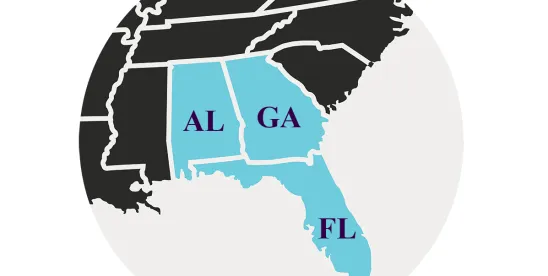
The 11th Circuit Court of Appeals has affirmed an $80 million ruling in favor of Skanska USA and Granite Construction against their joint-venture partner Lane Construction. The case involves a $2.3 billion highway improvement project in Florida known as the “I-4 Ultimate Project,” a public-private partnership (or “P3”) project for the Florida Department of Transportation. The court found that Lane breached its duties to its joint venture partners when it tried to pull out of the project before completion without good grounds for doing so. We previously wrote about the trial court decision that prompted this appeal to the 11th Circuit here.
The case is a must-read glimpse behind the scenes of a mega project in trouble due to unexpected cost overruns. The introduction from the 11th Circuit is excerpted below to whet your appetite and a complete copy of the opinion is available here.
Not all ventures strike gold; some strike sinkholes. Such was the case for a private group of contractors who shouldered Florida’s largest and most expensive construction project to date. The task was to expand and revamp Florida’s Interstate 4 highway (“I-4”), which runs between Tampa and Daytona Beach. Three contractors—Skanska USA Civil Southeast, Inc. (“Skanska”), Granite Construction Company (“Granite”), and The Lane Construction Company (“Lane”)—formed a joint venture (“SGL”) to take on the job. SGL secured a winning bid of $2.3 billion, projecting some $255 million in profit. But hurricanes, inflation, a labor shortage, and a series of unfortunate events turned profit-seeking into loss-mitigation. SGL soon found itself more than half a billion dollars in the red.
A few years into the project, Lane pitched the idea of ditching construction altogether. Lane knew SGL had no right to abandon ship, but its lawyers claimed they had concocted a legal theory to escape without liability. Alternatively, Lane and its lawyers suggested SGL threaten to walk away as a negotiation tactic. Either option would put a stop to the bleeding, or so Lane argued. Skanska found it too risky. Lane’s proposal rested on a series of tenuous legal assumptions, and if even one failed, SGL could face uncapped damages. Successful or not, the reputational damage would be untold. But to Lane, Skanska’s concern was a mere façade overlaying an odious conflict of interest. Skanska’s sister company was financing the construction in exchange for milestone payments and an exclusive maintenance agreement worth $75 million a year. Lane surmised that Skanska’s parent company stood to lose more from jeopardizing those payments than it would gain from stemming SGL’s losses.
Lane cried foul. It sued Skanska for breach of fiduciary duty and began refusing mandatory capital calls. Skanska and Granite countersued for breach of contract. After a ten-day bench trial, the District Court found that Skanska exhibited no dual loyalty and acted in the best interest of SGL. It ordered Lane to pay $80 million for refusing to fund the venture while litigation pended. We affirm.
The court then proceeded to describe in detail the wrangling between the joint venture partners over their termination rights under the contract (which included typographical errors that fueled the dispute), alleged conflicts of interest, and refusals to make capital call. The case is a cautionary tale to contractors and attorneys in complex construction disputes to carefully consider the grounds and consequences of termination before you pull the trigger.
A full copy of the court’s decision is available here.